

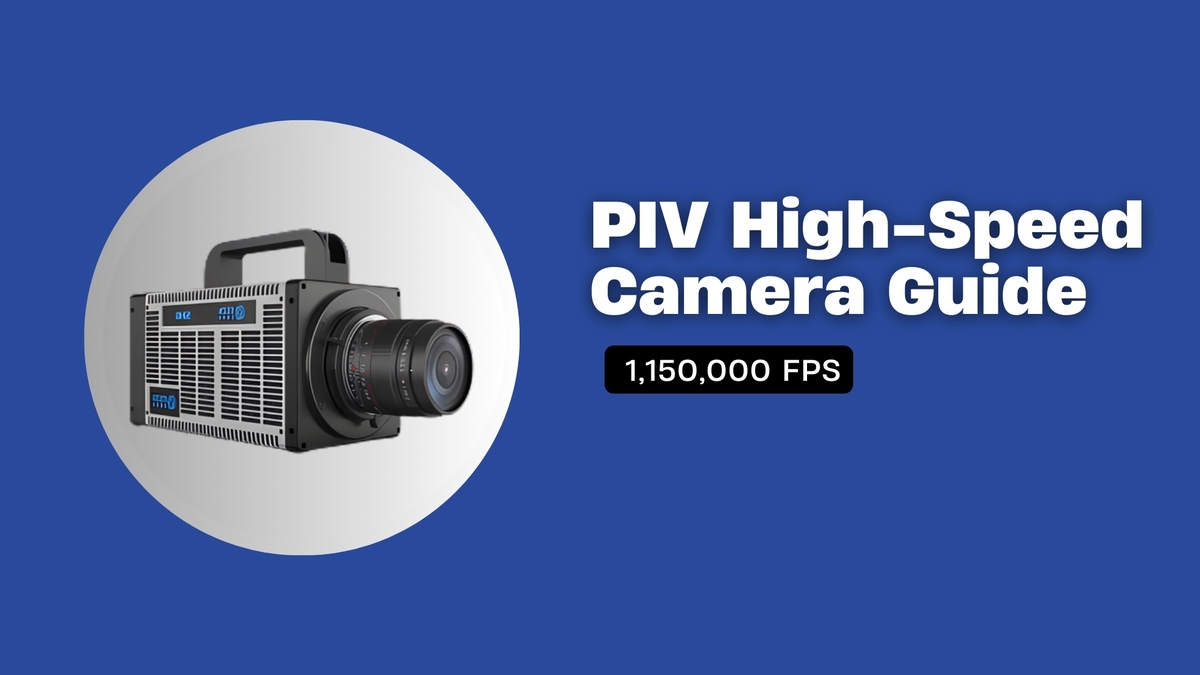
PIV High-Speed Camera Guide: SinceVision SH6 Series and 210ns Intervals for Microfluidic Accuracy
The HPC Thermal Bottleneck: The Need for Precision PIV
As AI-driven high-performance computing (HPC) scales, traditional cooling methods have hit a physical plateau. The industry is rapidly pivoting toward in-chip microfluidic systems, capable of enhancing heat removal by up to 3 times. However, optimizing these channels requires visualizing fluid dynamics at the micron scale.
For the fluid mechanics researcher, the primary barrier is the "Precision Gap." Standard high-speed imaging often fails to provide the sub-microsecond timing required for accurate Particle Image Velocimetry (PIV), leading to inaccurate velocity vectors and the "loss-of-pairs" phenomenon.
Technical Solution: The SinceVision SH6 Series Architecture
The SinceVision SH6 Ultra-high Speed Series is architected specifically to bridge this gap. By combining nanosecond timing with extreme sensitivity, it serves as a dedicated diagnostic platform for microfluidic and aerosol research.
1. Eliminating "Loss-of-Pairs" with 210ns PIV Intervals
In micro-PIV, high fluid velocities within a small field of view (FOV) mean tracer particles can exit the interrogation window between exposures.
- The Problem: Standard cameras with 1µs intervals often capture blurred streaks rather than discrete points.
- The SH6 Solution: The SH6 features a dedicated 210ns PIV cross-frame interval. This sub-microsecond timing enables sequential image capture with the precision required for advanced cross-correlation analysis, ensuring tracer particles remain within the window for accurate vector calculation.
2. Freezing Motion with 100ns Minimum Exposure
Combined with the inter-frame interval, the SH6 offers a 100ns minimum exposure time. This capability "freezes" hyper-transient events—such as droplet breakup or vapor chamber phase changes—eliminating motion blur. This results in a high signal-to-noise ratio (SNR), which is essential for identifying individual tracer particles in light-starved microscopic environments.
3. High Sensitivity for Micro-Scale Illumination
Micro-PIV research is inherently limited by light levels due to high magnification.3 The SinceVision SH6 addresses this with world-class sensors featuring a 14.6µs pixel size. This large pixel area provides superior photon-gathering capability, capturing faint tracer signals without the excessive noise that typically compromises data integrity in scientific imaging.

Get the Training You Need for a Safer Workplace!
Autonomous mobile robots are one of the fastest-growing segments of the robotics industry. During this live virtual training, you'll be introduced to safety protocols and best practices for working with mobile robots in industrial settings.
Learn more and register now for upcoming training dates.
Related Posts

Yifan Motor to Launch Next-Gen Robot Joint Motors at Automate 2026 – Precision Motion Control for Robotics & Beyond
Yifan Motor to Launch Next-Generation Robot Joint Motors at Automate 2026 Precision Motion Control for…
Tolomatic at Automate 2026 to Showcase Advanced Motion Solutions
Tolomatic, Inc. will be showcasing its innovative motion solutions at Automate 2026, taking place June…

Yifan Motor to Unveil High-Performance Coreless DC Motors at Automate 2026 – Powering the Future of Robotics & Automation
Precision Motion Control for Robotics & Medical Applications – Exhibiting at Booth CHICAGO, IL –…
Leave a Reply