


How AI Is Changing Scientific Discovery: From Hypothesis to Breakthrough
For centuries, scientific discovery followed a familiar rhythm. A researcher observed a pattern, formed a hypothesis, designed an experiment, collected data, and slowly worked toward a conclusion. However, progress was often limited by human capacity, how much data could be processed, how many variables could be tested, and how long it took to notice meaningful patterns.
That rhythm is changing. Artificial intelligence is not replacing the scientific method, but it is reshaping every step of it. From how hypotheses are generated to how breakthroughs emerge, AI is accelerating discovery in ways that would have seemed impossible just a decade ago.
From Human Intuition to Machine-Augmented Insight
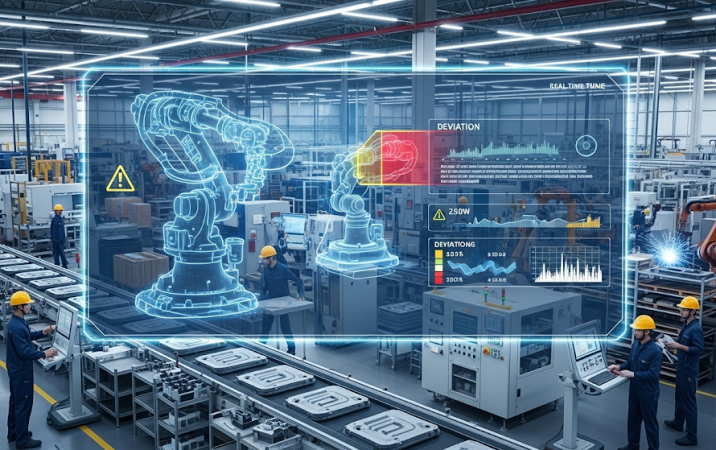
Traditionally, hypotheses begin with human intuition and educated guess grounded in theory and experience. AI expands this process by scanning vast datasets and identifying patterns that humans might never notice.
Machine learning models can detect subtle correlations across millions of data points, suggesting new research directions that are not obvious from existing theories.
This does not eliminate the scientist’s role. Instead, it changes it. Researchers now work alongside AI systems, using them as tools for exploration. Human judgment still decides which questions matter and which patterns are meaningful, but AI helps surface possibilities faster than intuition alone ever could.
Speeding Up Experimentation Without Cutting Corners
One of the most dramatic impacts of AI is in experimentation. Simulations that once took months can now be run in hours. In fields such as materials science, drug discovery, and climate modeling, AI systems can test thousands of experimental conditions virtually before a single physical experiment is conducted.
This shift saves time, reduces cost, and lowers risk. Failed experiments are no longer dead ends; they become data that refine the model. Scientists can focus their lab work on the most promising candidates rather than guessing where to start.
Making Sense of Overwhelming Data
Modern science produces more data than any human team can fully analyze. Genomics, astronomy, neuroscience, and particle physics all generate datasets so large that traditional analysis methods struggle to keep up.
AI excels in this environment. It can sift through noise, recognize complex patterns, and continuously learn as new data arrives. More importantly, it allows scientists to ask deeper questions. Instead of spending years organizing data, researchers can focus on interpreting results and designing better experiments.
NEW ONLINE TRAINING COURSE
Designing Industrial AI Agents
Gain the skills to orchestrate advanced AI agents that learn, adapt, and collaborate like experts in real-world automation environments
Redefining Collaboration and Discovery
AI is also changing who gets to participate in scientific discovery. Researchers with limited resources can now access powerful analytical tools that were once reserved for elite institutions. Cloud-based AI platforms and open-source models are lowering barriers, enabling broader collaboration across countries and disciplines.
This democratization of discovery increases the pace of innovation.
When more minds can test ideas, challenge assumptions, and build on each other’s work, breakthroughs emerge faster and more often.
The Human Role Still MattersMore Than Ever
Despite its power, AI does not discover in isolation. It does not understand meaning, context, or ethical implications. Humans still decide what problems are worth solving, how results should be interpreted, and how discoveries should be applied responsibly.
In fact, as AI becomes more capable, the human responsibilities become heavier. Scientists must question model assumptions, guard against bias, and ensure that automated insights align with reality. AI accelerates discovery, but human judgment anchors it.
From Hypothesis to Breakthrough Reimagined
The scientific method is not being replaced, it is being expanded. Hypotheses are now informed by both theory and data-driven insight. Experiments are guided by predictive models. Breakthroughs emerge not from slow, linear progress, but from rapid iteration and collaboration between humans and machines.
Conclusion
AI is transforming scientific discovery from a process limited by human capacity into one amplified by computational intelligence. By accelerating hypothesis generation, experimentation, and data analysis, it allows scientists to move faster and think bigger.
Yet the heart of discovery remains human curiosity, skepticism, creativity, and responsibility.
The future of science belongs not to AI alone, but to scientists who know how to work with it.

Asamaka Industries Ltd
Asamaka Industries Ltd specializes in providing comprehensive control automation solutions across multiple industries including automotive, power generation, and distribution. From electrical design to implementation of advanced technologies like robotics and vision systems, we cater to the unique needs of each sector, ensuring safety, quality, and efficiency in every project.
Discover how Asamaka Industries Ltd can support your automation journey with their complete range of solutions and expertise.
Related Posts
High-resolution 1.2 MP time-of-flight technology for fast, precise 3D data in any environment
IDS Imaging Development Systems GmbH is expanding its 3D portfolio with Nion, an industrial ToF…
IDS at VISION 2026
Product and technology innovations from IDS at booth 8C60: Trends, innovations, future. IDS Imaging Development…

SinceVision to Unveil New 3D Laser Profiler with Embedded Vision at VISION 2026
The manufacturing floor is getting a major visual upgrade. As industrial automation demands higher throughput…
Leave a Reply