


All-In-One Linear Actuators | Saving Engineers Development Time & Money

Faster Deployment, Greater Reliability, Lower Maintenance
This paper examines the implications of a fully integrated linear drive system. By consolidating sensors, control electronics, and drive components into a single compact unit, integrated motors reduce setup time, simplify supply chains, and improve system reliability. Advanced features are enabled through this tight integration, such as low-latency closed-loop control and high-fidelity haptic effects that are difficult to achieve in traditional modular systems. Beyond technical performance, these systems lower the total cost of ownership by minimizing cabling, reducing maintenance needs, and extending service life. This analysis highlights how integrated designs create new opportunities across manufacturing, automation, and other fields where compactness, precision, and durability are critical.
Traditional linear motors require external components like position sensors, electrical drives, controllers, cabling between these components, and software to tie everything together. By contrast, fully-integrated linear motors integrate essential sensors, amplifiers, and logic controllers into a single device. This consolidation of separate system components reflects a broader trend driven by advancements in integrated circuits and silicon technologies. As industries demand faster development cycles, higher reliability, and systems that can be deployed without deep hardware expertise, fully integrated linear motors offer a clear advantage. They reduce complexity for engineers, broadened accessibility for users who may not have specialized motion control knowledge, and enable advanced capabilities that modular systems lack.
What is a Fully-Integrated Linear Motor
A fully integrated linear motor is a compact, all-in-one linear drive system that contains its own motor driver, controller, and advanced suite of force, position, and temperature sensors within a sealed enclosure. Traditional modular systems, by contrast, do not communicate independently; all of their sensing, logic, and communication are handled by external components. In a traditional system, these external components must be sourced, connected, and calibrated individually, with each interface adding additional wiring, introducing points of failure, mechanical complexity, and latency between components.
A fully integrated linear motor is a compact, all-in-one linear drive system that contains its own motor driver, controller, and advanced suite of force, position, and temperature sensors within a sealed enclosure. Traditional modular systems, by contrast, do not communicate independently; all of their sensing, logic, and communication are handled by external components. In a traditional system, these external components must be sourced, connected, and calibrated individually, with each interface adding additional wiring, introducing points of failure, mechanical complexity, and latency between components.
Technical Advantages of an All-In-One Linear Actuation System
1. Simplified Integration & Accelerated Deployment
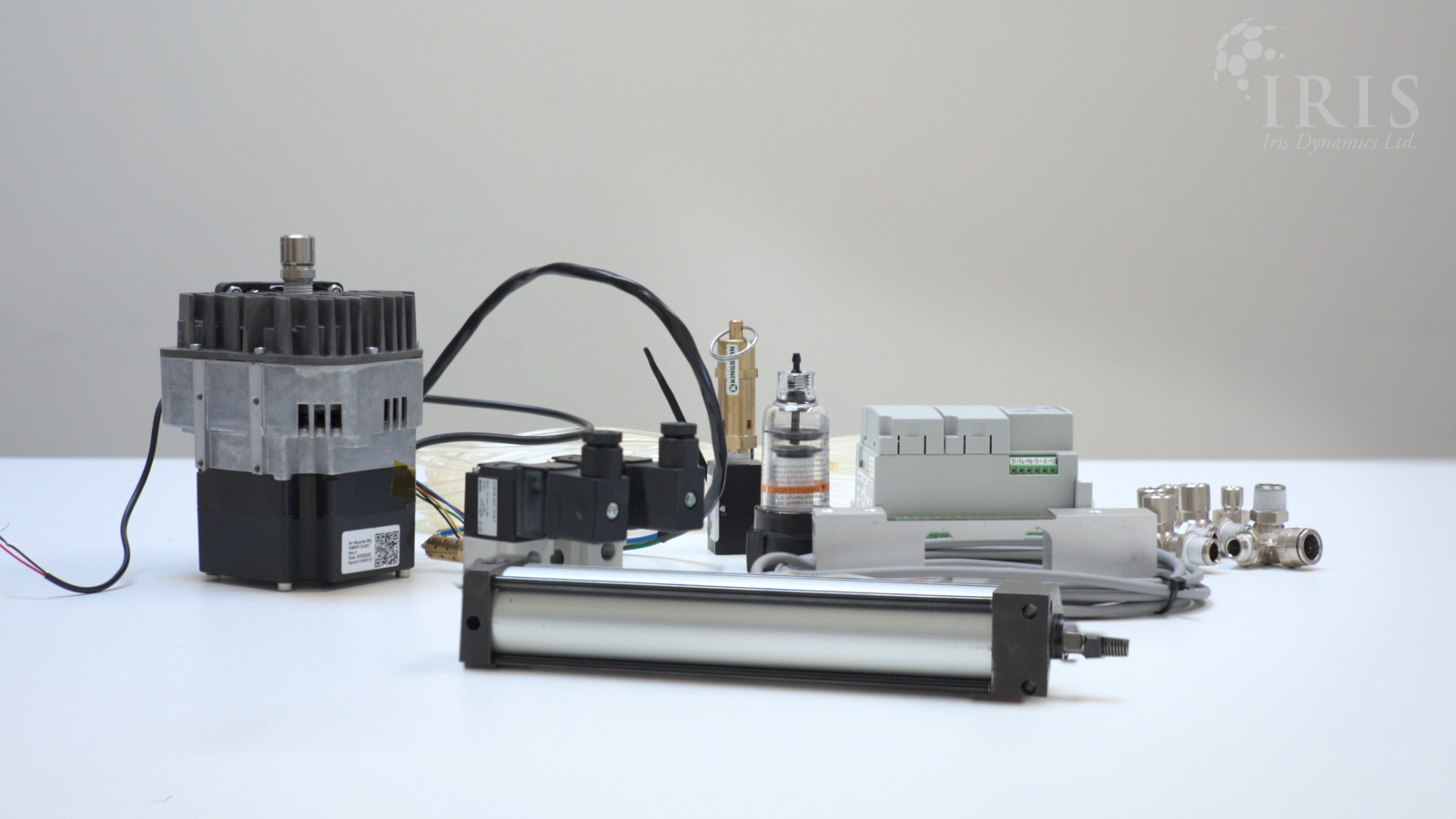
An all-in-one drive system design saves engineers valuable development time and money in several ways. It eliminates the need to source various components from different suppliers, integrate them, calibrate them so they communicate efficiently with one another, and test for compatibility. Traditional linear motors with external auxiliary components require specialized knowledge to set up, additional wiring, and often require days to install. Due to their tight integration, all-in-one linear motors can remain compact units, reducing wiring overhead and fitting easily in space-constrained applications. ORCA motors can function as drop-in replacements for pneumatic systems, integrate seamlessly with existing software, and support various interfaces including Python, C++, Modbus RTU, MATLAB, LabVIEW, and PWM modules.
.png) |
 |
.png) |
| Components Required to Setup a Leadscrew Actuator | Components Required to Setup a Pneumatic Actuator | Components Required to Setup an ORCA Motor |
2. Enhanced Performance: Low Latency Enables high-Fidelity Haptics
Position and force sensors, controllers, and drive electronics are designed and calibrated together during manufacturing, eliminating communication delays and compatibility issues that arise in traditional modular systems. Every component is tuned to work seamlessly as a single system, which improves both responsiveness and stability. ORCA motors’ closed-loop architecture enables real-time sensing and control, with sub-millisecond response times suitable for highly dynamic applications. Integrated position and force sensing provide continuous feedback to the control loop, improving accuracy and stability compared to systems where sensors and controllers are externally connected. Low-latency control not only enhances precision, responsiveness, and consistent performance but also enables advanced effects such as high-fidelity haptics, smooth damping, vibration control, complex oscillations, dead stops, and more.

Get the Training You Need for a Safer Workplace!
Autonomous mobile robots are one of the fastest-growing segments of the robotics industry. During this live virtual training, you'll be introduced to safety protocols and best practices for working with mobile robots in industrial settings.
Learn more and register now for upcoming training dates.
Related Posts

DEVELOP LLC Joins TLMI to Bring End-of-Line Automation Expertise to the Label Industry
DEVELOP LLC Joins TLMI to Bring End-of-Line Automation Expertise to the Label Industry FANUC Authorized…

The Emerging Direction of ISO/IEC TS 22440
This excerpt was originally published as part of a full article on the SRES website. Introduction…
Mainstay Digital Announces Mainstay One 3D Digital Asset Program for Automation OEMs
Plano, TX, September 29, 2026 Mainstay Digital, an industrial product visualization studio specializing in complex…
Leave a Reply