


CES 2026: Qualcomm Targets NVIDIA Jetson with New Robotics Developer Platform
Qualcomm didn’t spend too much time discussing robotics when it announced it was acquiring Arduino last year. We devoted a bit of column space the Southern California silicon giant’s plans, courtesy of an interview with VP, Manvinder Singh, but it looks as if it was ultimately keeping its powder dry for a big CES announcement.
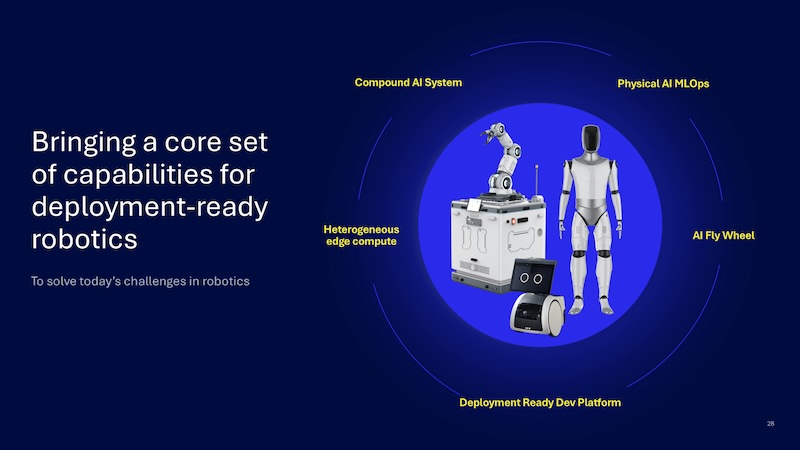
After debuting new additions to its compute and IoT portfolios, Qualcomm this morning showed the world Dragonwing 1Q10, a new 18-core CPU at the heart of its 2026 robotics strategy. While the Arduino acquisition finds the company looking to get in on the ground floor with startups, developers, researchers, and all-around DIY tinkerers, Dragonwing is designed to offer a more full-stack solution for manufacturers ready to scale and deploy a broad range of robot form factors.
Much like so many other industries at the moment, NVIDIA’s the 500-pound gorilla in the space (complacency’s not a great look for the world’s most valuable company). Jetson’s various iterations have established the company as, arguably, robotics’ biggest developer platform, marking a steep hill for Qualcomm to climb. Discussing Jetson’s genesis with Automated, NVIDIA’s Deepu Talla recounted boss Jensen Huang’s guidance, "if you're not at least 10 years before a market or a technology takes shape, you're probably late." Notably, that referred to the company’s then-risk exit from mobile processing into the robotics space.
No one – least of all NVIDIA – will argue that premium smartphone processor market was ceded outright to Qualcomm. The company’s SoCs (systems of a chip) have achieved a level of ubiquity rarely seen in consumer electronics. Ultimately, however, one questions whether Qualcomm might be late to the game here, given NVIDIA’s headstart and subsequent market saturation.
Just about everybody who is anybody in robotics and physical AI has tripped over themselves to incorporate some part of the Jetson ecosystem.
In a pre-brief ahead of this week’s big Vegas show, Qualcomm touted its own headstart, in the form of Snapdragon Ride, its on-going work in autonomous driving. In September, Qualcomm announced it had jointly developed the Snapdragon Ride Pilot Automated Driving System with BMW, set to debut on the German carmaker’s iX3 later this year. As for who it will convince to make the jump over to Dragonwing, the company name checks Advantech, APLUX, AutoCore, Booster, Figure, Kuka Robotics, and Robotec.ai.
"Figure's mission is to develop general-purpose humanoid robots powered by advanced AI to eliminate unsafe and undesirable jobs, boost productivity across industries, and create economic abundance that enables happier, more purposeful lives for humanity,” Figure CEO Brett Adcock, says in a release tied to the news. “Qualcomm Technologies’ platform, with its combination of exceptional compute capabilities and energy efficiency, is a valuable building block in enabling Figure to turn our vision into reality."
The autonomous driving to robotics pipeline is well established at this point. There’s no way we’re having these sorts of conversations about robotics and AI ion 2025/2026 without the billions in funding poured into self-driving over the past decade. That work has put sensors, navigation systems, and compute within reach for companies look to build more capable and adaptable robotics systems.
“As pioneers in energy efficient, high–performance Physical AI systems, we know what it takes to make even the most complex robotics systems perform reliably, safely, and at scale,” per Qualcomm EVP. Nakul Duggal. “By building on our strong foundational low-latency safety-grade high performance technologies ranging from sensing, perception to planning and action, we’re redefining what’s possible with physical AI by moving intelligent machines out of the labs and into real-world environments.”
The launch partners certainly represent a range of form factors from industrial arms (Kuka) to humanoids (Figure). Manufacturing/industrial customers are clearly a big part of this first wave. In its press material, Qualcomm touts, “industry‑leading power efficiency, safety, and scalability to personal service robots, industrial AMRs, and full‑size humanoids.” Each form factor presents its own unique challenges in terms of control and safety, particularly when terms like “personal service robots” are used to – presumably – refer to robots interacting with humans outside of a cage in a non-industrial environment.
Language in the announcement hedges the project's status somewhat, noting that Dragonwing helps the company and its partners, "take a significant step toward practical, real‑world deployment across industrial applications." VLAs and VLMs look to be a particular focus for the platform and its partners.
Association for Advancing Automation
Discover how Association for Advancing Automation can support your automation journey with their complete range of solutions and expertise.
Related Posts

Which Automation Investments Will Pay Off? Explore Physical AI at IEX 2026
DBR77, a member of the Association for Advancing Automation (A3), will host IEX 2026: Physical…

Hitachi Appoints Yusuke Kazama as JR Automation CEO
JR Automation, a Hitachi Group company and global leader in intelligent automation solutions, today announced…
Synapticon and Reynolds & Moore Partner to Close the Safety Gap in Humanoid Robotics
Schönaich, Germany, and Dallas, United States, October 1, 2026 - Synapticon GmbH, a developer of integrated…
Leave a Reply