


China Just Made “Robot Technician” an Official Job. That Matters.
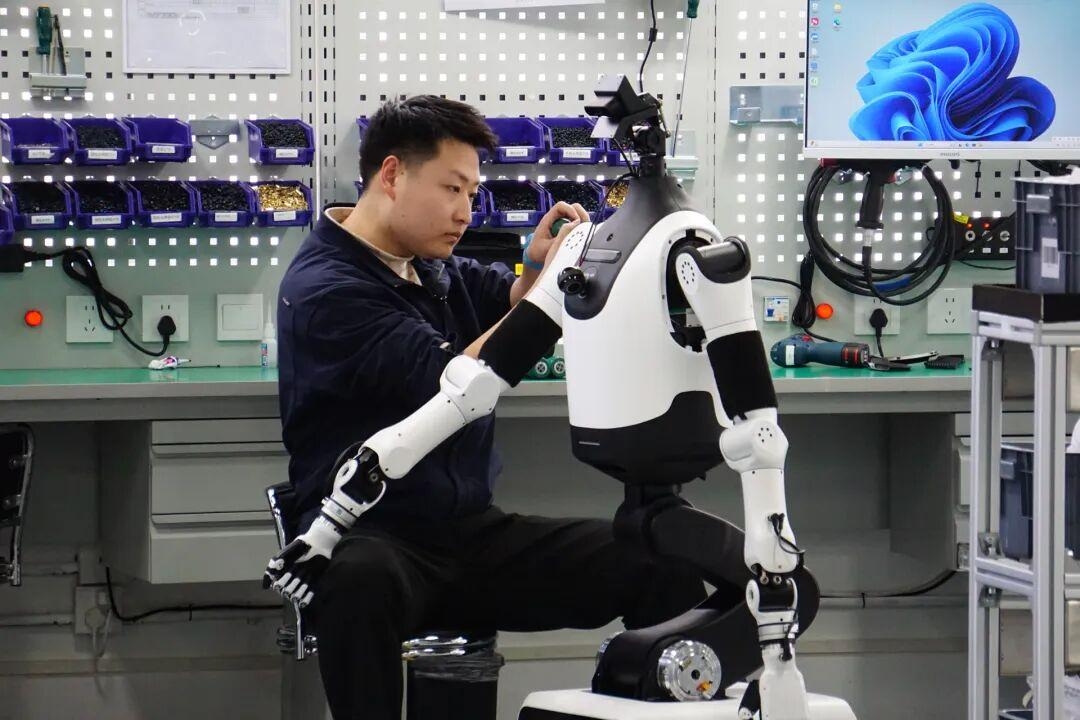

China spends plenty of time talking about how many robots it intends to build. This week, it did something potentially more important for actually deploying them: it formally recognized the people who will help make them work.
China's Ministry of Human Resources and Social Security has added 11 occupations to the country's official occupational classification system. Among them is embodied intelligence robot technician, a new occupation covering workers who deploy, train, monitor and maintain increasingly intelligent robotic systems.
It would be easy to dismiss this as an administrative change to China's labor classifications. It is more significant than that. China isn't simply building an embodied-AI industry. It is beginning to formalize the workforce infrastructure around it.
This Isn't Just Robot Maintenance
The definition of the occupation is particularly interesting.
The Chinese occupational description covers workers using teleoperation equipment, spatial digitization tools and simulation platforms to collect and process multimodal robot data. Responsibilities can also include adapting and fine-tuning models, deploying and commissioning hardware and software, monitoring performance, diagnosing failures and optimizing maintenance.
That's considerably broader than someone standing beside a robot with a toolbox. The role sits somewhere between today's automation technician, robot integrator, field-service technician, data specialist and AI technician. It reflects an important change in what maintaining a robot could mean as machines become more autonomous.
Traditional industrial robot technicians already deal with controllers, sensors, servomotors, pneumatics, hydraulics, vision systems and programming. Those skills aren't disappearing. Embodied AI adds another layer. Workers may increasingly collect training data, test models in simulation, adapt robot behavior and investigate failures that originate in perception or AI models rather than purely mechanical or electrical systems.
The robot technician is starting to become an AI technician.

The Workforce Behind Physical AI
Much of the humanoid discussion has focused on production capacity.
Which company can manufacture 10,000 robots? Who can reach 100,000? How quickly can costs fall? When will humanoids become inexpensive and reliable enough for widespread commercial deployment?
Those are important questions. But there is another scaling problem that receives far less attention: Who deploys all of them?
A robot arriving at a factory isn't the end of the automation process. Someone has to configure it for the application, integrate it with other equipment, validate its performance, monitor it and troubleshoot it when something goes wrong. Multiply that across tens of thousands of increasingly sophisticated machines and another constraint begins to emerge. You need people who know how to make the robots work.
China appears to be preparing for that problem.
Five of the 11 New Jobs Are Digital
The robot technician wasn't China's only technology-related addition.
Five of the 11 newly recognized occupations are classified as digital occupations, including digital twin engineering technician, embodied intelligence robot technician and industrial product digital modeler. They represent 45.5% of the latest additions. Look at those occupations together and an interesting picture emerges.
Digital models increasingly represent products and manufacturing systems. Digital twins connect physical operations with virtual environments. AI systems add intelligence. Embodied-intelligence technicians help connect that intelligence back to physical machines. This begins to look less like a collection of unusual new job titles and more like the human infrastructure of the increasingly digital factory. China's government says national occupational standards will follow, helping guide vocational education, skills training and talent assessment. Since 2019, China has recognized eight batches totaling 121 new occupations.
That's the part automation executives elsewhere should be watching.

America Already Has Robot Technicians
The United States isn't starting from zero.
The U.S. Department of Labor's O*NET system already recognizes Robotics Technicians, defined as workers who build, install, test or maintain robotic equipment and related automated production systems. Listed tasks include troubleshooting robotic systems, programming controllers, creating 3D simulations and even training robots using AI software or interactive techniques. So the lesson isn't that China has invented a job America doesn't have.
The more interesting question is how quickly the job itself changes.
China's new occupation explicitly brings together physical deployment, multimodal data collection, model adaptation, simulation, commissioning and ongoing performance optimization. Those responsibilities point toward a technician working much closer to the intersection of AI and the physical machine.
The Next Automation Skills Gap
Manufacturers already struggle to find electricians, controls engineers, maintenance technicians, welders and other skilled workers.
Physical AI could add another shortage.
Factories may increasingly need people who understand enough mechanics to diagnose an actuator, enough controls engineering to understand the automation system, enough networking to troubleshoot connectivity, enough robotics to commission the machine and enough AI to recognize when the problem isn't mechanical at all.
That doesn't necessarily mean hiring armies of computer scientists.
In fact, one of the largest workforce opportunities created by physical AI may sit between the traditional skilled trades and the engineering department. Think technical colleges, associate degrees, apprenticeships and employer training.
That training infrastructure is already beginning to evolve in the United States. At the Association for Advancing Automation (A3), for example, training now spans introductory industrial robotics, robot safety and risk assessment, collaborative and mobile robot safety, machine vision, motion control and industrial AI.
A3 is also working to expand access to that training. In Ohio, A3 and the Mahoning County Career & Technical Center recently launched a statewide initiative backed by a $499,000 workforce grant. The program is expected to support approximately 3,000 individual robotics and automation course enrollments through June 2027, including training in industrial robotics, robot safety, mobile robot safety and the business case for automation.
Those programs don't yet amount to a single American curriculum for the embodied-intelligence technician China has now defined. But they provide many of the building blocks. The next generation of automation training will increasingly need to connect disciplines that historically have been taught separately: robotics, controls, safety, vision, networking, data and AI. The workforce challenge isn't simply producing more robot technicians. It is making sure the skills associated with that job evolve as quickly as the robots themselves.

The Business Case Includes the Workforce
For automation buyers, this is more than a labor-market issue.
A robot that cannot be deployed, supported or maintained economically is not a scalable automation solution. Technician availability affects commissioning time, uptime, service costs and ultimately return on investment. That becomes even more important as automation moves beyond highly structured applications.
Traditional industrial robot installations often rely on integrators and experienced plant automation teams. Physical-AI systems promise greater flexibility, but flexibility doesn't eliminate the need for technical support. It changes the skills that support requires. That workforce therefore becomes part of the infrastructure required to scale physical AI.
Companies building humanoids and other embodied-AI systems will need manufacturing capacity. They will need supply chains, capital, computing infrastructure and customers willing to deploy the technology. They will also need people capable of making those machines productive after they arrive.
China's decision to formally recognize the embodied intelligence robot technician is an early acknowledgment of that reality. The physical-AI race won't be decided only by who manufactures the most robots or develops the most capable models. It may also be decided by a much more practical question:
Who has enough people capable of making all those robots actually work?
Association for Advancing Automation
Discover how Association for Advancing Automation can support your automation journey with their complete range of solutions and expertise.
Related Posts
Which Automation Investments Will Pay Off? Explore Physical AI at IEX 2026
DBR77, a member of the Association for Advancing Automation (A3), will host IEX 2026: Physical…

Hitachi Appoints Yusuke Kazama as JR Automation CEO
JR Automation, a Hitachi Group company and global leader in intelligent automation solutions, today announced…
Synapticon and Reynolds & Moore Partner to Close the Safety Gap in Humanoid Robotics
Schönaich, Germany, and Dallas, United States, October 1, 2026 - Synapticon GmbH, a developer of integrated…
Leave a Reply