


NSF puts $30M behind the next challenge for physical AI: Humans
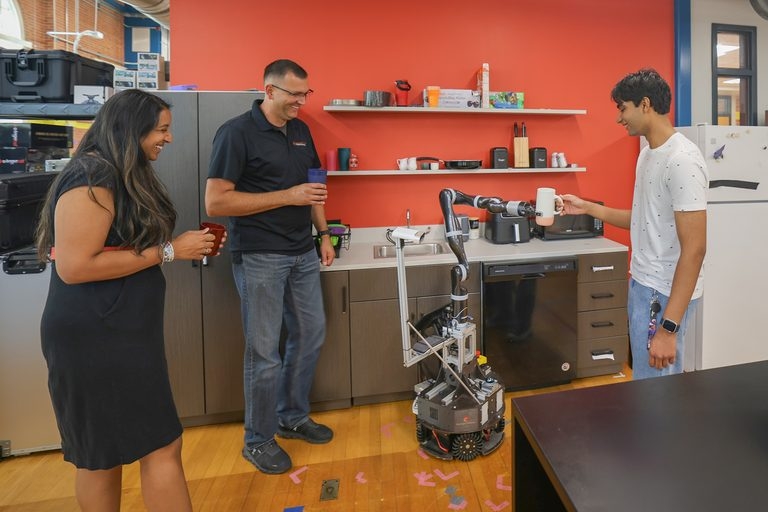
The University of Texas at Austin will lead a new $30 million National Science Foundation research center focused on a problem the robotics industry will increasingly have to solve as machines move beyond factories and warehouses: People are unpredictable, and they change over time.
The five-year Center for Human and Robot Co-Adaptation will bring together 39 researchers from six universities to study how people and robots learn from one another and adjust their behavior during long-term interactions. Rather than measuring whether a robot can successfully perform a task during a demonstration, researchers want to understand what happens after that machine has spent months or even years operating around the same people.
The research could have implications well beyond academia. Amazon, Apptronik, Diligent Robotics, Google DeepMind, Hello Robot, MassRobotics, NVIDIA and Robust AI are among the industry collaborators participating in the center, bringing together companies working across humanoids, mobile manipulation, artificial intelligence and commercial robotics.
That industry involvement points to a growing challenge for physical AI. Making robots more capable is only part of the path toward broader adoption. Companies will also need machines that can remain useful as their users, tasks and operating environments change.
“The next leap in robotics is not just getting robots to perform more tasks,” said Joydeep Biswas, an associate professor of computer science at UT Austin who will serve as the center’s director. “It is enabling robots to understand the people around them: their needs, preferences, values and constraints, while recognizing that people also adapt their behavior when they integrate robots into their environment.”

Moving beyond the robot demo
Robotics has traditionally benefited from controlling as many variables as possible. Industrial robots operate in carefully designed workcells. Parts arrive in predictable locations. Processes are engineered around repeatability, and barriers, sensors and other safeguards help separate people from potential hazards.
Even newer generations of collaborative robots and autonomous mobile robots generally operate within defined workflows and environments. The system may adapt to changing conditions, but there are still boundaries around what it is expected to encounter.
Physical AI is pushing robotics beyond those assumptions. Robots being developed for healthcare, elder care, hospitality, construction and eventually the home will operate in environments that cannot easily be redesigned around the machine.
The challenge is not simply that these environments change. The people within them change as well.
A robot assisting someone recovering from an injury, for example, could encounter different physical capabilities from one week to the next. An older adult's needs could change over several years. Workers may develop new ways of interacting with a robot after learning what it does well and where it struggles.
The center calls this process “human-robot co-adaptation.” Instead of looking only at how a robot learns to work around people, researchers will study how both sides of the relationship change.
That distinction could become commercially important. A robot that performs well during a pilot but cannot adapt as workflows, users or expectations change may struggle to deliver value over its operating life.
.png)
The robot needs to know more than the task
UT Austin uses a simple example to illustrate the problem. Teaching a robot to set a table is relatively straightforward. Getting that robot to recognize that someone is making chili and include soup spoons without being explicitly instructed requires a much deeper understanding of context, behavior and preference.
Healthcare offers a more consequential example. An assistive robot could learn how to adjust its reach based on a person's physical limitations so that the individual can take a drink of water. At the same time, the person learns what the robot is capable of doing and how to request assistance.
That creates a feedback loop in which both sides change their behavior.
For robotics companies, this introduces a different performance question. Success is no longer simply whether a robot completes a task reliably. The system may also need to determine whether yesterday's successful behavior is still appropriate today.
That could require persistent models of users and environments, better contextual understanding and systems capable of learning without introducing unpredictable behavior. It also raises questions around privacy, safety, consent and how much autonomy a continuously adapting robot should have.
Those issues become considerably more complicated when robots move from controlled workplaces into homes, hospitals and assisted-living facilities.
Getting robots out of the lab
The center plans to study those challenges through a network of real-world deployment locations called the Human Environment with Robots, or HERO, Facility Network.
Sites will include houses, dormitories, cafés, a public museum, a rehabilitation hospital, and elder-care and assisted-living residences at UT Austin and its partner institutions: the Massachusetts Institute of Technology, Yale University, Indiana University Bloomington, the University of Utah and Tufts University.
The real-world component could be one of the center's most important contributions.
The robotics industry has become very good at demonstrations. Commercialization requires something different. Robots must continue functioning when furniture moves, routines change, objects appear where they aren't expected and people behave differently than the training data predicted.
Long-duration deployments could also help researchers understand what happens after the novelty of having a robot nearby disappears. Workers and residents may develop shortcuts, change how they communicate with machines or discover uses that developers never anticipated.
Community members at the HERO sites will have opportunities to influence how, when and where robots are deployed. An internal ethics board will oversee the research and develop consent and opt-out procedures, an important consideration for systems that could continuously learn from human behavior in sensitive environments.
NVIDIA, Apptronik and the physical AI connection
The center also connects human-robot interaction research with several of the technologies now driving investment in physical AI.
UT Austin's Texas Advanced Computing Center will provide computing resources for simulation, machine learning, data storage and digital twins of HERO sites. Researchers will be able to test approaches virtually before introducing them into environments such as dormitories or nursing homes.
NVIDIA will contribute accelerated computing, simulation and robotics platforms. Researchers will use those technologies for large-scale training and evaluation while also examining foundation models intended to support human-robot collaboration and adaptation.
“For robots to become a part of daily life, they must stay useful as people's needs, tasks and environments change over time,” said Deepu Talla, vice president of robotics and edge AI at NVIDIA.
Apptronik brings a more direct hardware connection. The Austin-based humanoid developer spun out of UT Austin's Human Centered Robotics Lab in 2016. Researchers plan to incorporate Apptronik's physical robotics designs and computing models into work exploring safe humanoid deployments in human environments.
The participation of Diligent Robotics, Hello Robot and Robust AI adds experience with other forms of mobile manipulation and robots designed to work around people, while Amazon and Google DeepMind bring perspectives from large-scale automation and artificial intelligence.
Together, those partners make the center more than an academic exercise. They create a potential bridge between fundamental research into human behavior and the commercial platforms trying to move physical AI into everyday environments.

Adaptation could become a business requirement
The commercial significance of co-adaptation may ultimately come down to utilization and return on investment.
A robot designed around a narrow task can generate value when that task occurs frequently enough to justify the investment. That model has worked exceptionally well in automotive manufacturing and other highly repetitive applications.
Many of the markets physical AI companies are now targeting are different. Tasks vary, environments change and customers may expect the same robot to perform more functions over time.
That changes the economics.
If a robot can learn a user's preferences, adjust to changing workflows and acquire new capabilities without requiring extensive reprogramming or systems integration, its useful operating envelope becomes larger. A machine capable of doing more useful work over a longer period has a better chance of generating the utilization needed to support the investment.
Conversely, a robot that requires constant engineering intervention every time the environment or workflow changes could be technically impressive and still struggle commercially.
That is why co-adaptation could eventually become more than a human-robot interaction research problem. It could become part of the business case for general-purpose robotics.
The other side of physical AI
For much of robotics history, industry solved variability by engineering it out of the environment. Factories were designed around robots because robots were extremely productive when the world around them remained predictable.
The next generation of robotics is attempting something substantially harder.
Physical AI promises machines that can perceive, reason and act in environments that were designed for people rather than robots. Foundation models, simulation, improved manipulation and more capable hardware are all pieces of that transition.
But putting robots into human environments creates another variable that cannot simply be engineered away: humans.
People will learn how robots behave. Workers will change workflows around them. Patients may discover new ways to use assistive systems. People may develop trust in certain capabilities and skepticism toward others. In some cases, users could become dependent on machines in ways their developers never anticipated.
The commercial winners in physical AI therefore may not simply be the companies that build robots capable of performing the largest number of tasks.
They may be the companies that build robots capable of remaining useful as the people, workplaces and expectations around them change.
NSF is putting $30 million behind figuring out what that relationship looks like. For an industry spending billions of dollars trying to move robots out of controlled environments and into the human world, the answer could have significant implications for which systems actually stay there.
Association for Advancing Automation
Discover how Association for Advancing Automation can support your automation journey with their complete range of solutions and expertise.
Related Posts

DEVELOP LLC Joins TLMI to Bring End-of-Line Automation Expertise to the Label Industry
DEVELOP LLC Joins TLMI to Bring End-of-Line Automation Expertise to the Label Industry FANUC Authorized…

The Emerging Direction of ISO/IEC TS 22440
This excerpt was originally published as part of a full article on the SRES website. Introduction…
Mainstay Digital Announces Mainstay One 3D Digital Asset Program for Automation OEMs
Plano, TX, September 29, 2026 Mainstay Digital, an industrial product visualization studio specializing in complex…
Leave a Reply