

Real-Time Weld Guidance in Lithium Battery Production: Why the SD33-85 Changes the Equation
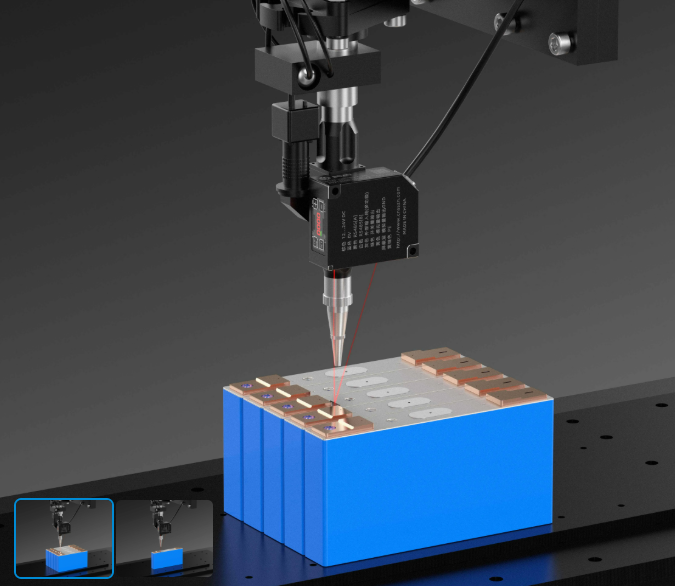
Top cover welding in square aluminum shell batteries is the longest continuous weld in the cell. It is also the most exposed. Unlike sealing nails or busbars, this weld subjects the entire perimeter to thermal stress. Shell deformation happens. Gap variation happens. Fixture tolerances stack up every shift.
You can program the perfect weld path. But the workpiece is never perfect.
This is not a failure of your robotics. It is the physical reality of aluminum and heat.
The Limits of What We've Been Doing
Pre-programmed Z-axis paths assume consistency that does not exist on the production floor. Offline teaching captures one moment in time; a perfect part, cold, unloaded. It cannot account for stacked tolerances from upstream stamping and assembly. It cannot predict thermal expansion during the weld cycle itself. And it certainly cannot respond to micro-gaps at the shell-cover interface that exceed 0.05mm.
Contact-based sensors have their place, but not here. They lag. They wear. In a process where the weld joint is moving at 100mm/second, contact feedback arrives too late.
We are not criticizing existing equipment. We are recognizing the natural evolution of process maturity. The question is no longer can we weld it, but can we weld it consistently, at volume, at 99.95% success rates.
That question demands real-time weld guidance that lithium battery manufacturers can depend on.
Why Real-Time Z-Axis Compensation Matters
A weld joint is not static. It expands. It shifts. It responds to energy input as the laser travels. The metal is living through a phase change, and you are asking it to behave predictably.
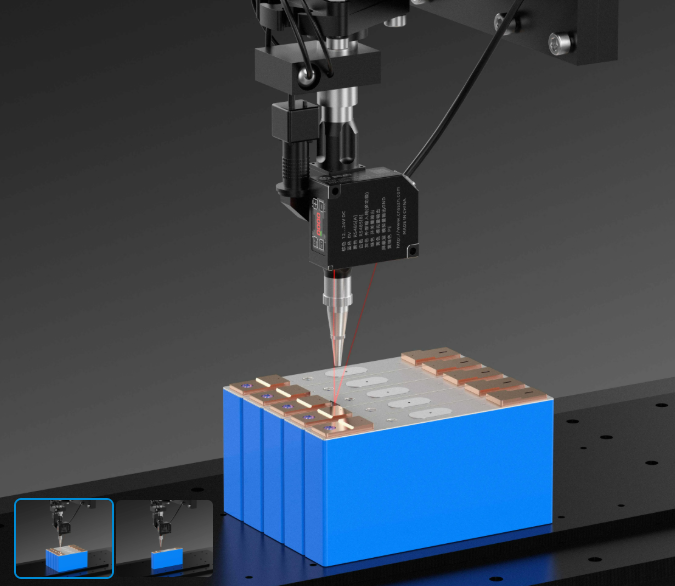
The SD33-85 laser displacement sensor top weld solution does not simply measure distance. It provides continuous closed-loop feedback. The laser head does not follow a preset path; it breathes with the workpiece. When the shell rises 15 microns due to thermal expansion, the Z-axis adjusts. When a gap opens at the corner radius, compensation happens before the weld bead degrades.
Speed matters here more than most engineers realize. The sensor's 3 kHz sampling rate is not a datasheet boast. It is the difference between catching a 10-micron deviation and missing it. At modern welding speeds, that sampling frequency translates to one measurement every 0.03mm of travel. You are not reacting to problems; you are preventing them.
"In top cover welding, every micron of uncontrolled Z-axis deviation is a bet against your own throughput. The SD33-85 does not ask you to take that bet."
Built for the Welding Floor, Not the Laboratory
The SD33-85 battery production sensor uses BSI-CMOS technology with a built-in amplifier. You do not need external controllers or signal conditioners. It is self-contained, like a reliable shift lead who does not need supervision.
Certified System Integrator Program
Set Yourself at the Forefront of the Global Vision Market
.jpg) Vision system integrators certified by A3 are acknowledged globally throughout the industry as an elite group of accomplished, highly skilled and trusted professionals. You’ll be able to leverage your certification to enhance your competitiveness and expand your opportunities.
Vision system integrators certified by A3 are acknowledged globally throughout the industry as an elite group of accomplished, highly skilled and trusted professionals. You’ll be able to leverage your certification to enhance your competitiveness and expand your opportunities.
Ten-micron repeatability. Not laboratory precision, shop-floor precision. In an environment of vibration, EMF noise, and occasional weld spatter, this sensor holds its line. We have validated this across battery gigafactories in Germany, Korea, and China. The conditions vary. The performance does not.
IP67 protection and ESD shielding are standard. We have seen sensors fail from a single electrostatic discharge. This one is built for real factories, where ground loops happen, and cable routing is not always ideal.
Integration uses RS485 and analog output. Your existing PLC will recognize it immediately. This is not a custom protocol requiring specialist knowledge. Connection takes an afternoon, not a project timeline.
Integration Without Redesign
We understand the concern: another sensor means another variable, another potential point of failure.
The SD33-85 was designed as a weld guidance instrument, not an add-on. The compact form factor of 60×50×22mm fits existing weld heads without mechanical redesign. You are not re-engineering your cell. You are adding precision to what already works.
The digital display panel allows line-side adjustment by senior technicians. You do not need to pull a programmer off another line to change a threshold or verify a reading. The sensor respects the knowledge of the people running the process.
Z-Axis Compensation Welding That Earns Trust
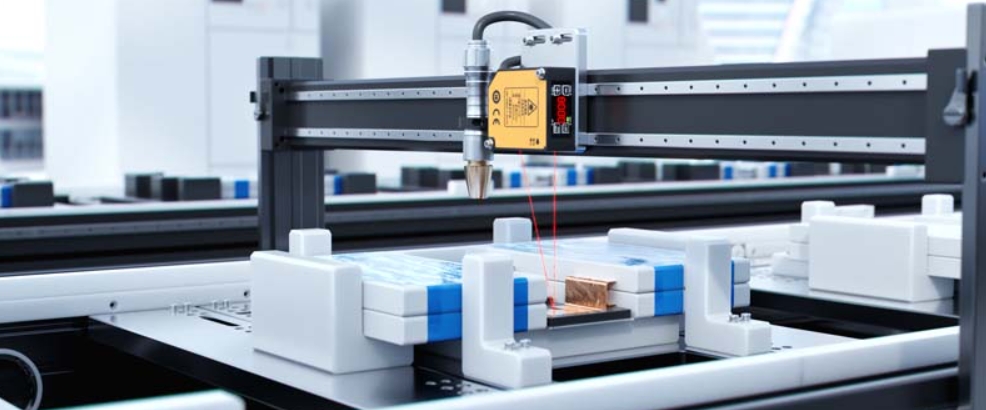
The industry is moving toward 99.95% weld success rates. This is not about avoiding defects. It is about making defects statistically irrelevant. Real-time weld guidance in lithium battery production achieves this by removing the largest uncontrolled variable: the assumption that parts arrive perfect and remain perfect during welding.
They do not. They never have.
The SD33-85 does not eliminate that gap between the ideal part and the real part. It closes it, in real time, weld after weld. It compensates for what teaching pendants cannot predict and what offline programming cannot anticipate.
You have spent years tightening tolerances upstream, improving fixtures, and refining weld parameters. Those efforts matter. But at some point, you stop fighting the part and start working with it as it actually is: thermally expanding, microscopically shifting, behaving like the piece of stamped aluminum it is.
That is what real-time Z-axis compensation welding delivers. Not perfection. Consistency. Yield. Trust in the process.
We have spent decades watching the gap between what robots are told to do and what parts actually need. The SD33-85 does not eliminate that gap; it closes it, in real time, weld after weld.

Shenzhen SinceVision Technology Co. Ltd.
SinceVision is a world-class sensor technology manufacturer for 3D laser profilers, high-speed cameras, laser displacement sensors, spectral confocal displacement sensors, full-spectrum sensors, and through-beam edge sensors.
Discover how Shenzhen SinceVision Technology Co. Ltd. can support your automation journey with their complete range of solutions and expertise.
Related Posts
ABB Robotics launches PickMaster Lite to simplify & accelerate robotic picking
ABB Robotics launches simplified version of its PickMaster software for packaging OEMs and system integrators…
ABB Robotics launches new automated surface finishing cell
New, plug-and-play OmniVance Collaborative Surface Finishing Cell empowers small and medium-size enterprises to automate key…
Fraunhofer IPA certifies knife edge for Montech cleanroom belt conveyors
Charlotte, April 27, 2026– Montech brings its proven knife edge into the cleanroom: The product…
Leave a Reply