

What Manufacturers Need to Know Before Investing in Custom Automation
A Machine Buyer's Guide
By Steven Douglas Corp. | Exhibiting at Automate 2026 — Booth 26011
Custom automation machines are increasingly the foundation of modern manufacturing operations — particularly in electrical, automotive, medical device, and consumer manufacturing. But before approving a capital budget or requesting a quote, manufacturers need to understand what custom automation really involves: financially, technically, and strategically.
Check out the Full Buyer's Guide on Steven Douglas Corp.'s website.
What Is a Custom Automation Machine?
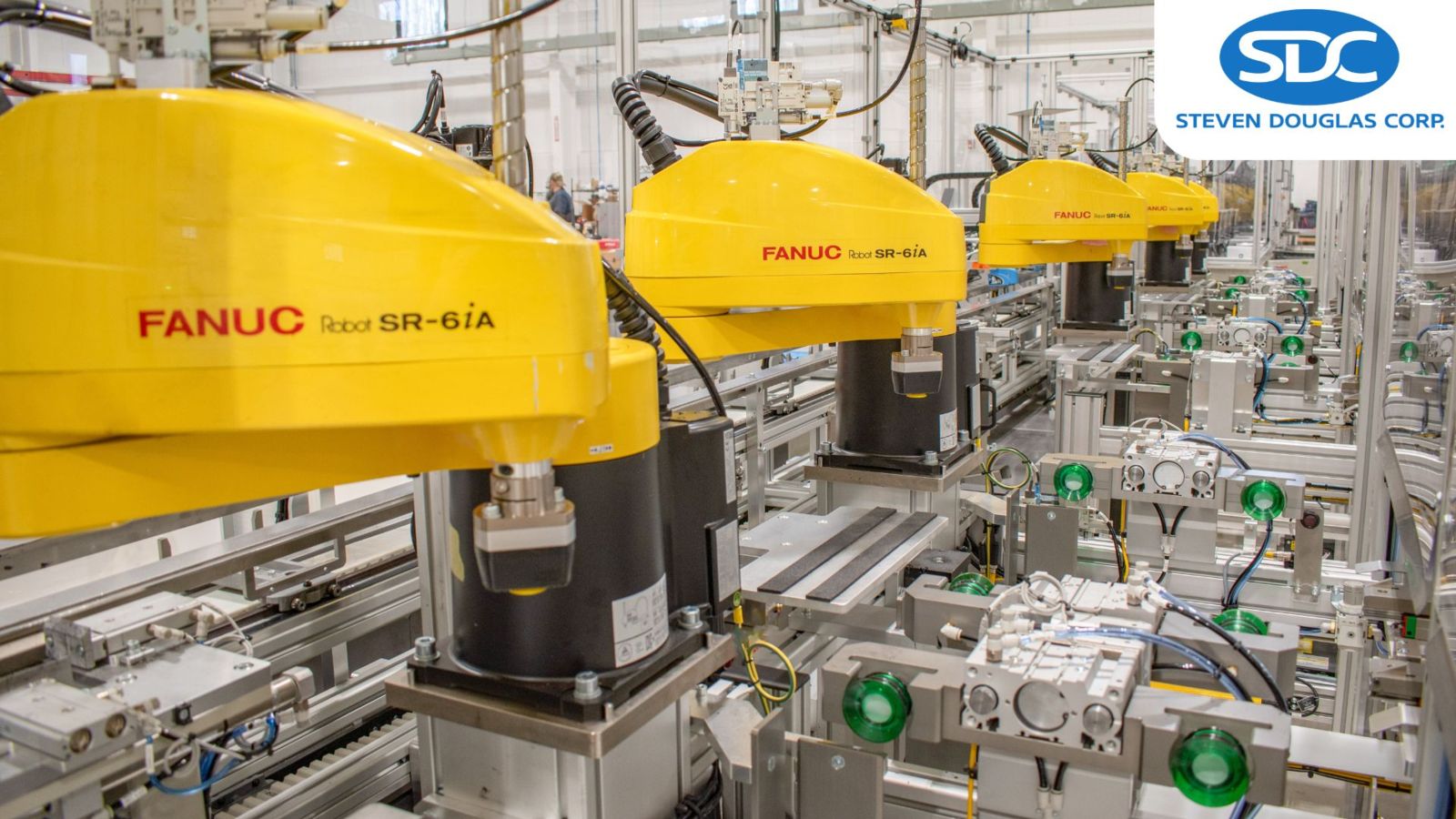
A custom automation machine is a purpose-built industrial system engineered around a specific process, product geometry, and production target — not a generalized application.
Unlike standard off-the-shelf equipment, custom automation systems are designed from the ground up to meet exact cycle times, tolerance requirements, quality standards, and integration constraints. They're built for real-world manufacturing conditions: part inconsistencies, high-volume output, robotic integration, AI-powered inspection, and future scalability.
When Does It Make Financial Sense?
The most common drivers behind custom automation investment include:
- Labor shortages or high turnover
- Inconsistent manual quality
- Safety risk exposure
- Cycle time bottlenecks
- High scrap or rework rates
A practical ROI framework considers labor exposure, throughput gains, and scrap reduction together. A process that runs at 20 seconds per unit manually and 12 seconds automated represents a 40% output increase — often enough to eliminate bottlenecks, defer capital spending elsewhere, or free capacity for growth. Defect rate reductions from 4–5% down to under 1% can compound quickly in precision-driven industries.
Typical payback timelines range from 16 weeks for semi-automated cells to 52+ weeks for fully integrated systems, but ROI is only part of the picture. For many manufacturers, the greater value is stability — knowing the most critical process will perform tomorrow exactly the way it performed today.
What Does It Cost?
Custom automation systems reflect the engineering required to make them reliable and scalable. Realistic investment ranges:
- Semi-automated station: $150,000 – $350,000+
- Single-station system: $200,000 – $600,000+
- Multi-station machine: $500,000 – $1.5 million+
- Fully integrated line: $1M – $5 million+
Two machines that look similar on paper can vary 2–3x in cost based on engineering depth, controls architecture, safety design, and long-term support structure. Choosing based on lowest upfront price is one of the most common — and costly — mistakes manufacturers make.
Why Projects Fail (And How to Avoid It)
Most custom automation projects don't fail because the technology doesn't work. They fail because fundamentals were missed early. The most common causes:
Poorly defined requirements. If throughput targets, quality metrics, and product variation aren't clearly established before engineering begins, the machine builder is forced to make assumptions — and those assumptions become change orders.

Get the Training You Need for a Safer Workplace!
Autonomous mobile robots are one of the fastest-growing segments of the robotics industry. During this live virtual training, you'll be introduced to safety protocols and best practices for working with mobile robots in industrial settings.
Learn more and register now for upcoming training dates.
Related Posts

DEVELOP LLC Joins TLMI to Bring End-of-Line Automation Expertise to the Label Industry
DEVELOP LLC Joins TLMI to Bring End-of-Line Automation Expertise to the Label Industry FANUC Authorized…

The Emerging Direction of ISO/IEC TS 22440
This excerpt was originally published as part of a full article on the SRES website. Introduction…
Mainstay Digital Announces Mainstay One 3D Digital Asset Program for Automation OEMs
Plano, TX, September 29, 2026 Mainstay Digital, an industrial product visualization studio specializing in complex…
Leave a Reply