

Machine Learning For Energy Management In Industrial Facilities

Machine Learning For Energy Management In Industrial Facilities
Global decarbonization focuses its attention on energy-intensive industries including manufacturing plants, heavy-industry campuses, and processing environments. The International Energy Agency found that alone in the developed economies data centres will be responsible for exceeding 20% of the electricity demand growth by 2030, more than conventional industrial applications. Increasing energy price tags and demands on sustainability reporting give industrial operators a reason to explore smarter solutions to utilize with the help of AI. Energy management systems (EMS) powered by machine learning (ML) are among them, and it is quite likely that ML will soon become a strategic resource and an operational necessity as energy management gains precise and efficient solutions via ML.
INTRODUCTION
Industrial plants are experiencing two different forces; as energy costs have been increasing and there has been a stricter towing of environmental standards. The traditional approach to management has been unable to keep up with real-time complexity through the use of traditional management practices: scheduling, reactive maintenance and rule-based control. A scalable solution is provided by ML: predicting demand, anomaly detection in real-time, optimizing operations, and predictive maintenance. The real-world applications of ML technologies evolve together with the technologies themselves and generate impressive results in terms of energy savings, uptime, and financial investment payback.
Energy Forecasting and Demand Response

Efficient energy is all about determining what, and at what time to utilize. In complex consumption data identification, ML is an expert.
●Forecast accuracy: ML models are better at making forecasts compared to conventional methods of forecasting. According to Spacewell, forecasting applications with the help of AI facilitate balanced demands and production schedules in real-time so that participating in the demand-response programs can be effective.
●Demand response: ML enables facilities to move heavier loads, such as kiln firing, large compressors or power-peaking-machines to non peak times. Using the smart grid connection, operators can maximize the energy cost and get a grid incentive.
●Impact: Using smarter forecasting and load shifting can slash peak charges and stabilize power consumption load and, in many cases, can be paid off within 12-24 months (ROI: Return on Investment).
Prescriptive and Predictive Maintenance
Unscheduled stoppage in the industrial side of things has been costing companies and businesses up to $1.4 trillion per year. Maintenance systems powered by Machine Learning assist in failure predestination and optimum maintenance.
●Predictive maintenance: IoT sensors are utilized to gather vibrations, acoustic emissions, temperature and runtime measurements. ML Models bring up anomalies prior to slip-up.
Reports indicate that unplanned downtime has been reduced by up to 50 percent with maintenance costs savings of between 10 and 40 percent.
Real-world examples:
General Electric installed AI-based predictive maintenance in its facility and attained several uptime benefits. Aquant and Gecko Robotics combine robotics and ML technologies to detect the problem, e.g. corrosion, before it becomes a critical situation. One of the Business Insider reports notes savings of up to 23% of the annual service expenses of such companies as Coca-Cola and Siemens Energy.
● Prescriptive maintenance: The recent development with anomalies detected, the systems suggest the corrective measures, which can be replacement, lubrication, and even a shutdown, as well as enable conversational AI assistants to query the system. This practice is likened to having a GPS of maintenance since uncertainty is cut down, and efficiency is intensified. System Optimization: Heating, Ventilation, Cooling and Operations HVAC and production-line reduction are one of the low-hanging fruits that ML should be integrated into.
● A.I. Controlled HVAC: Based on the idea of Google DeepMind, that saved 40% of the energy used to cool down data centres by dynamically adjusting cooling systems with the help of deep learning techniques, such models can be used to manage large-scale HVAC facilities within an industrial plant.
● Intelligent Microgrids and Storage: Hybrid microgrids have onsite renewables (solar, wind), combined with battery storage. The HybridOS 11 platform of FlexGen utilizes ML in controlling the storage performance and the integration of renewable energy. Amazon employs ML to optimize battery storage functions that are related to renewables, in order to minimize emissions as well as to boost efficiency.
● Real-time Energy Arbitrage: Real-time energy arbitrage relies heavily on the power of ML algorithms to manage energy reservoirs to purchase, store and dispatch electricity according to market prices or market signals such as grid supply/demand.
Energy Benchmarking and Anomaly Detection
The fact that ML can learn the normal consumption and identify anomalies is revolutionary when it comes to efficiency.
●Anomaly detection: ML systems are highly sensitive and will detect leaks, inefficiencies or unusual patterns of operations so that early action can be taken on them.
● Efficiency Benchmarking: asset-level performance across time and peer is compared in multivariate ML systems and can be used to observe which are laggards and when to focus on upgrading.
● Cyber Resilience: In its most recent review, TEA Springer observes that the ML-based means in the energy sector involve shielding against cyberattacks, in addition to efficiency enhancement.
Economic Outlook and Market Trends

The modernization of AI in the field of energy is becoming intense.
● Market Growth: The global AI-in-energy market surged from $5.24 billion in 2024 to $6.79 billion in 2025—a 29.7% year-on-year rise and is projected to reach $17.03 billion by 2029 (CAGR 25.8%).
● Policy Support: The new industrial strategy has provided the UK with up to 2.8billion on advanced manufacturing R&D, along with financing of AI-powered clean energy schemes, with an aim of cutting industrial electricity in half in 2027 onwards.
Certified Motion Control Professional Program
Strengthen Your Skills and Enhance Your Career
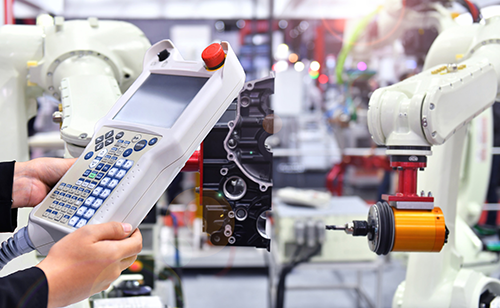 Motion control is ubiquitous to automation. A3 offers the fundamental knowledge that benefits everyone working with motion control, motors and automation technologies. The program is designed to ensure professionals have the knowledge they need to advance their careers and benefit their businesses.
Become a Certified Motion Control Professional (CMCP) and join the elite group of system integrators, machine builders, manufacturers, end-users and others recognized in the industry for their professional knowledge and expertise.
● Data-center Dynamics: IEA estimates that electricity demand would double by the year 2030 due to the intensive data-centre utilisation of AI, which further strengthens the necessity of smart energy systems.
Case Studies And Proof Of Concept
1. GE Predictive Maintenance The ML used in the AI programs of GE examines historical and real-time sensor data and allows predictive maintenance and significant increases in uptime.
2. Digital Oil & Gas Maintenance
A Bitstrapped-developed project also provided cloud-based ML simulations of offshore facilities that allow predicting failures and observing per-unit facility asset happenings all over the US.
3. Maintenance Of Energy-intensive Equipment
A scholarly paper revealed that solar or hybrid-powered plant fastened with ML and IoT reduced idle time and enhanced energy performance, by delivering predictive maintenance.
4. Smart Battery Management Platforms
The ML models developed by Amazon optimize the use of storage space in terms of ensuring adequate charge/discharge inhibition and that the HybridOS 11 of FlexGen is optimizing energy flows within micro-grids.
5. Predictive-prescriptive Fusion
Waites Sensor Technologies integrated vibration sensors and LLMs, which allows technicians to query equipment status like, “What are the most problematic machines?”
Challenges and Enablers
The adoption of ML-power energy is not a smooth one. But through specific strategies, obstacles can be broken.I. Data Readiness Good data lies in the basis. It is difficult to find a granular IoT connection with legacy systems in most facilities. High resolutions, time stamped, structured data are essential to Machine
Learning (ML).
II. Upfront Investment
Capital is required to install sensors, improve infrastructure, and construct cloud or edge platforms. The ROI is usually attained within 12-24 months as verified by peer cases studies.
III. Workforce Adaptation
Technicians should have ML literacy and practical skill. There is also the fear of displacement of jobs. Nonetheless, research implies that ML augments human functions by making the work more cognizant and pro-active.
IV. System Integration
At real time, EMS needs to combine ML knowledge with an industrial control system (e.g., SCADA, PLCs). The adoption is hindered by fragmented systems. Integration is frequently streamlined with help of strategic partnering with vendors (Siemens, Schneider, GE, etc.)
V. Security and Governance
ML systems enhance connectivity and this enlarges the cyber-attack surface. AI in energy standards are gaining momentum to protect the integrity of data, resilience of systems, and privacy.
Best Practices For Adoption

In order to be successful, industrial leaders are to:
1. Focus on use cases: There is usually a reliable potential ROI, e.g. in predictive maintenance workflows, or to optimize HVAC.
2. Establish first-rate data infrastructure: Install sensors that record useful measures at adequate rating.
3. Pilot measurable objectives Repeatable: Use one plant or process to test, iterate, and measure ROI.
4. Collaborate with experts: Team up with experts that demonstrate successful experience with ML-EMS functionality (e.g., approaches by DeepMind, developed at Google, FlexGen OS, Aquant, GE).
5. Upskill staff: Train engineers and technicians to interface with ML insights and diagnostic tools.
6. Govern for sustainability: Watch over model drift, check predictions, and retrain data lines on a continuous basis.
The Future Trends

The important trends affecting industrial energy developments of ML are:
I. Prescriptive and Conversational AI – The combination of discovery of the anomaly, possible solutions, and collaborative technicians will become the norm.
II. Dynamic Load Management and Peer-to-grid trade – ML will facilitate dynamic load management and peer-to-grid trade of industrial clusters with dynamic VPP ecosystems and microgrids.
III. Transparency and Governance – The interpretability of ML will assist engineers in gaining confidence in predictions and investigating problems.
IV. Cyber-secure ML deployment – Resilience and secure ML designs will be important parameters as systems get networked.
V. Regulatory incentive– The availability of funds and government regulations (such as the UK clean-energy plan) will stimulate the use of ML-based EMS systems.
CONCLUSION
The situation in industrial energy management is at the stage of change. Machine learning provides industrial facilities with three strategic advantages:
Economic: Physical cost savings via demand optimization, peak shifting and predictive maintenance.
Operational: Better equipment availability, safer working environment and lower possible downtime.
Environmental: Reduced carbon emissions due to optimal energy consumption, renewable energy, and more intelligent system designs.
Using the data infrastructure along with strategic piloting and workforce skilled engagement, industrial operators will be able to utilize the true potential of ML. Businesses that adopt it early enough, when training staff, improving data flows and making systems more secure, will define the future where energy becomes an opportunity and a business advantage, than a simple cost. The path will cost money, take time, and require some hard work to get done, but the reward will be a slimmer, greener, more robust industrial energy sector. With the ML technologies moving to production, industrial sites are not only seeing the energy and cost savings, but spearheading the energy transition and transforming what the modern manufacturing process is.


Leave a Reply