
Bear Robotics Wants $300 Million. The Bigger Bet Is What Comes Next.
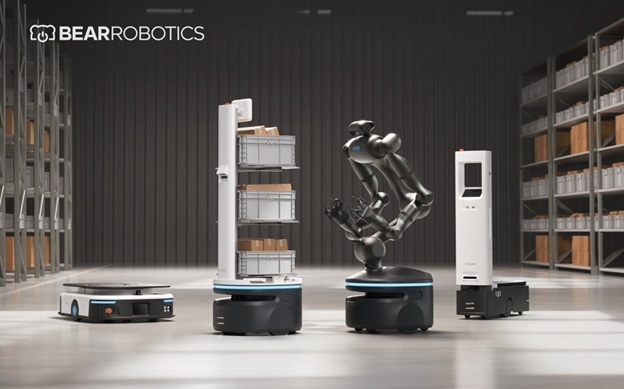

Bear Robotics became one of the most recognizable names in service robotics by building machines that carried plates through restaurants. Now the LG Electronics-controlled company may be preparing to ask investors to value it as something considerably bigger.
The Silicon Valley robotics company is reportedly seeking as much as 400 billion won, roughly $300 million, in pre-IPO financing ahead of a potential Nasdaq listing. Bank of America has reportedly been tapped to arrange the round, with Bear targeting institutional investors at a valuation of roughly 2 trillion won, or about $1.5 billion.
That would be a significant step up from the valuation associated with LG's $60 million investment in Bear in 2024. But the valuation is only part of the story. Investors would increasingly be underwriting Bear's attempt to move from restaurant service robots into a broader automation platform spanning autonomous mobile robots, industrial material movement, manipulation and eventually physical AI.
LG's role in that transition has grown quickly. The company invested $60 million in Bear in March 2024, initially acquiring a 21% stake. Less than a year later, LG exercised an option to acquire an additional 30%, giving it control of the company. LG also moved its CLOi commercial robot business into Bear, making the company a central piece of its commercial robotics strategy.

Bear Is Becoming Something Else
Bear has since pushed beyond hospitality. Its Carti platform targets warehouses and factories, while newer low-profile industrial AMRs extend the company's capabilities into heavier material movement. Bear says those machines are already being deployed in LG smart factories, giving the company something many robotics startups spend years trying to obtain: an industrial environment in which to develop, deploy and refine its technology.
Then Bear added manipulation. In June, the company announced the acquisition of UK-based Kinisi Robotics, bringing the KR1 wheeled humanoid and Kinisi's manipulation technology into the business. The acquisition adds vision-language-action models, robotic manipulation and robot foundation-model development to Bear's existing navigation, autonomy and fleet-management capabilities.
That changes the investment case considerably. Bear says it has shipped more than 16,000 robots into commercial service across North America, Europe and Asia. Instead of starting with a humanoid and then searching for commercially useful work, Bear is approaching physical AI from the opposite direction. It already has deployed robots, customers, navigation software, fleet-management infrastructure, manufacturing experience and operating data. The next challenge is adding more capable physical interaction to that base.
The robotics market is crowded with companies trying to prove that increasingly capable machines can perform useful work reliably enough to justify their cost. Bear has already crossed part of that divide with service robots and is attempting to repeat the process in industrial environments. The question is whether its experience moving objects through structured environments can translate into robots capable of manipulating those objects as well.
A $300 million financing round would provide substantial capital to find out. It would also give Bear resources to expand manufacturing, develop its manipulation stack, enter additional markets and potentially make further acquisitions as competition across physical AI accelerates.

Why Keep Bear Separate?
The corporate structure makes the reported financing particularly interesting. LG already controls Bear and has identified robotics as a future growth business. It could have simply continued absorbing Bear into the larger organization. Instead, the reported pre-IPO financing and potential Nasdaq listing suggest LG sees value in maintaining Bear as a distinct robotics company capable of attracting outside capital.
That could give Bear something increasingly important in a capital-intensive industry: its own financial currency. A separately listed robotics company could raise equity independently, use shares for acquisitions and potentially attract investors seeking direct exposure to robotics without buying into LG's much broader consumer electronics and appliance businesses.
It could also provide LG with a way to finance an expensive robotics expansion without carrying the entire investment on its own. Building industrial robots, developing physical AI models, expanding manufacturing and supporting commercial deployments all consume capital. Bringing institutional investors into Bear effectively spreads some of that burden while allowing LG to retain strategic control.
There are risks to that strategy. Bear remains in an investment-heavy stage as it expands R&D and enters new markets, while the economics of large-scale physical AI deployments remain unproven across much of the industry. A valuation around $1.5 billion would require investors to look beyond today's business and place considerable value on Bear's ability to turn its installed base, LG relationship and newly acquired manipulation capabilities into something much larger.
That is why the proposed financing matters beyond the headline number. The capital would not simply finance more Servi robots. It would help finance Bear's transition from robots that move things to robots that can increasingly interact with them.

The Bet Is Manipulation
That transition is becoming one of the most important dividing lines in physical AI. Autonomous navigation has matured significantly over the past decade, creating commercial markets for AMRs, delivery robots and service robots. Reliable manipulation remains much harder, particularly when robots leave tightly controlled environments and encounter changing objects, tasks and conditions.
Bear now has several pieces of that puzzle. Its existing fleet provides mobility and deployment experience. Kinisi adds manipulation and embodied-AI capabilities. LG provides manufacturing expertise, supply-chain scale, global distribution and industrial environments where the technology can be tested against actual production requirements.
There is also a potentially important advantage in how Bear arrived here. Much of today's physical AI investment is flowing toward companies developing humanoids first and building commercial deployment networks second. Bear has effectively followed the reverse path. It spent years putting relatively simple autonomous robots into customer environments before moving toward more complex machines.
That installed base matters because physical AI needs more than better models. It needs deployment infrastructure, fleet management, service networks, safety systems, customer relationships and the ability to manufacture and support machines at scale. Those are less visible than a humanoid demonstration, but they can determine whether a robot becomes a product rather than a prototype.
The proposed pre-IPO round would add another piece to that infrastructure: substantially more capital. If Bear succeeds in raising anywhere near $300 million at the reported valuation, the most interesting number may not be the amount of money it collects. It may be the roughly $1.5 billion investors are being asked to believe the company is worth.
That valuation is no longer primarily a bet on robot waiters. It is a bet that a company that learned how to move things through restaurants can become a platform for moving and eventually handling things across factories, warehouses and other commercial environments.
For Bear Robotics, the journey from Servi to physical AI may be just beginning.
Association for Advancing Automation
Discover how Association for Advancing Automation can support your automation journey with their complete range of solutions and expertise.
Related Posts

DEVELOP LLC Joins TLMI to Bring End-of-Line Automation Expertise to the Label Industry
DEVELOP LLC Joins TLMI to Bring End-of-Line Automation Expertise to the Label Industry FANUC Authorized…
The Emerging Direction of ISO/IEC TS 22440
This excerpt was originally published as part of a full article on the SRES website. Introduction…
Mainstay Digital Announces Mainstay One 3D Digital Asset Program for Automation OEMs
Plano, TX, September 29, 2026 Mainstay Digital, an industrial product visualization studio specializing in complex…
Leave a Reply