


Integrating AI in Safety-Critical Systems: Why ISO/IEC TS 22440 Changes the Game
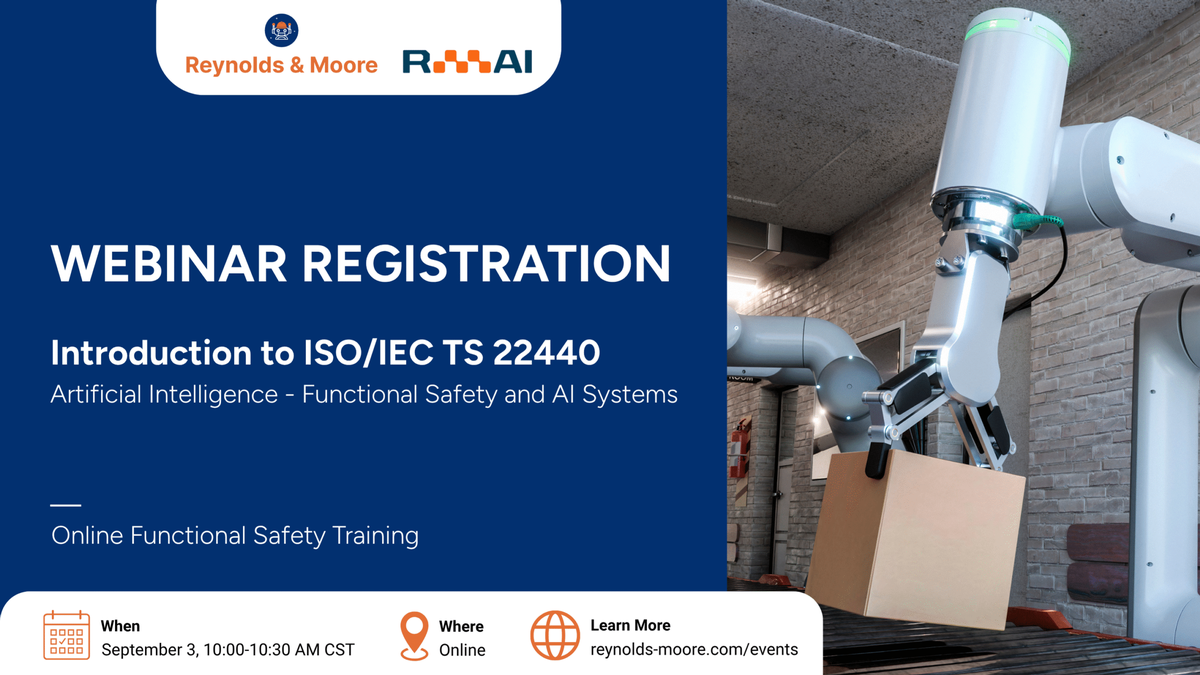
Artificial intelligence (AI) and Machine Learning (ML) are no longer experimental technologies as they’re becoming more essential to industrial automation, robotics, and safety-critical systems applications. From autonomous inspection robots in hazardous environments to AI-powered predictive maintenance tools, the potential for improved safety, efficiency, and decision-making is enormous.
But here’s the challenge: traditional functional safety standards, such as IEC 61508, were never designed to handle AI’s non-deterministic and adaptive nature. These standards assume systems behave predictably, that safety requirements can be verified through direct testing, and that failure modes are well understood. However, AI breaks these assumptions. Its behavior can evolve over time, it relies on complex data-driven models, and it can make “black box” decisions that are hard to trace.
This gap between traditional safety standards and AI capabilities has created uncertainty. Regulators, certification bodies, and industry leaders have been asking: How can we ensure that AI systems in safety-critical applications are reliable, explainable, and compliant?
Introducing ISO/IEC TS 22440
ISO/IEC TS 22440: Artificial Intelligence – Functional Safety and AI Systems is the first international standard designed specifically to address these concerns. It provides a structured methodology to analyze, assess, and mitigate AI-related risks for industrial applications.
This isn’t just an incremental update — it’s a fundamental shift. ISO/IEC TS 22440 lays out guidance for:
- Defining safety requirements for AI-enabled systems that can adapt over time.
- Evaluating AI models for reliability, robustness, and explainability.
- Integrating AI verification and validation into the broader functional safety lifecycle.
For organizations in regulated industries, this standard is a breakthrough. It creates a common language between engineers, regulators, and certification bodies, reducing the barriers to deploying AI responsibly.
Why This Matters for Industry
Without a recognized safety framework, AI systems, no matter how promising, struggle to gain acceptance. The consequences include delayed projects, costly redesigns, and in some cases, outright rejection by regulators.

Get the Training You Need for a Safer Workplace!
Autonomous mobile robots are one of the fastest-growing segments of the robotics industry. During this live virtual training, you'll be introduced to safety protocols and best practices for working with mobile robots in industrial settings.
Learn more and register now for upcoming training dates.
Related Posts

DEVELOP LLC Joins TLMI to Bring End-of-Line Automation Expertise to the Label Industry
DEVELOP LLC Joins TLMI to Bring End-of-Line Automation Expertise to the Label Industry FANUC Authorized…

The Emerging Direction of ISO/IEC TS 22440
This excerpt was originally published as part of a full article on the SRES website. Introduction…
Mainstay Digital Announces Mainstay One 3D Digital Asset Program for Automation OEMs
Plano, TX, September 29, 2026 Mainstay Digital, an industrial product visualization studio specializing in complex…
Leave a Reply